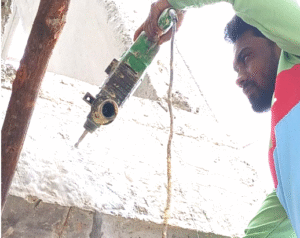
REPAIR WORK – Concrete Damage Solutions
Concrete structures often develop weak zones due to improper construction practices, environmental wear, or structural stress. These defects, if not addressed, can lead to severe leakages and compromise structural integrity. Aquaseal offers tailored repair solutions based on the nature of the defect and intensity of water ingress.
Common Types of Concrete Defects:
Cold Joints
Formed when there’s a delay between concrete pours, preventing proper bonding. These become potential weak points in the structure.Construction Joints
Occur where one concrete pour ends and another begins (e.g., between slabs or beams). Load transfer is managed using keys or dowels, but they require sealing to prevent leakage.Honeycombs / Voids
Caused by insufficient compaction, leaving hollow spaces that allow water to pass.Cracks
Result from improper mix design or inadequate curing, which leads to shrinkage and water ingress.Tie Rod Holes
Formed during shuttering; these are common leak spots and must be filled correctly.Pinholes
Small surface imperfections due to air bubbles or poor de-shuttering technique.
Moisture Entry Classification:
- Dampness
Slight moisture visible on the surface — can be arrested using cementitious plugs. - Seepage
Intermittent dripping of water — requires cementitious or epoxy grouting for effective sealing. - Leakage
Continuous, high-pressure water flow — best treated using PU injection grouting for rapid sealing.
Recommended Repair Solutions
1. Cementitious Repair Mortars
Used for repairing weak zones in dry or SSD (Saturated Surface Dry) conditions.
Types:
a) Polymer Modified Mortar
Components: Cement, sand, SBR latex, water
Mix Ratio: 1C : 3S : 0.15 SBR : 0.2W
Primer (Bond Coat): 1 Part SBR + 1 Part Cement
Pin Hole Filler: 5 Parts Cement + 500 ml Latex + 500 ml Water
b) Crystalline Mortar
Reacts with unhydrated cement and water to form waterproof crystals
Mix Ratio: 4-4.5 Powder : 1 Water
Coverage: 1–1.5 kg/RMT (25x25mm repair)
Primer Coat: 3 Powder : 1 Water
c) Epoxy Mortar
Solvent-free, 3-component repair mortar
Mix Ratio: 1:1:1
Coverage: 2 kg/mm/sqm
2. Cementitious Repair Plugs
a) Crystalline Plug (e.g., Penetron-Peneplug)
Used during active leaks
Mix: 1 kg Powder + 250 ml Water
Permanent waterproofing
b) Polymer Plug (e.g., Fosroc Renderoc Plug)
Temporary fix for dampness
Mix: 3 Part Plug + 1 Part Water
3. Cementitious Grouting
Fills internal voids using pressure pumping of cement slurry + admixtures.
Admixtures:
PRAH (for Hydrostatic Conditions)
E.g., Penetron Admix
Mix: 1 kg Cement + 500 ml Water + 10g PRAHPRAN (for Non-Hydrostatic Conditions)
E.g., Fosroc Cebex 100
Mix: 1 kg Cement + 500 ml Water + 4.5g PRAN4. Resin Injection Grouting
a) PU Injection Grouting
Used for active leaks
Reacts instantly with water
1K System: Con Repair CYH-500
2K System: Sika-201 CE
Mix: As per manufacturer (usually 1:1)
b) Epoxy Injection Grouting
Slower setting, used for structural strength
Rigid, with excellent bond strength
Not ideal for flexible applications
Key Notes Before Application:
All repair areas should be in SSD condition.
Primer coat is essential before applying repair mortars.
Proper surface preparation ensures effective bonding and long-lasting repairs.